Top 12 Commercial Banks in Nigeria 2026: Rankings, Charges and Full Cost Breakdown
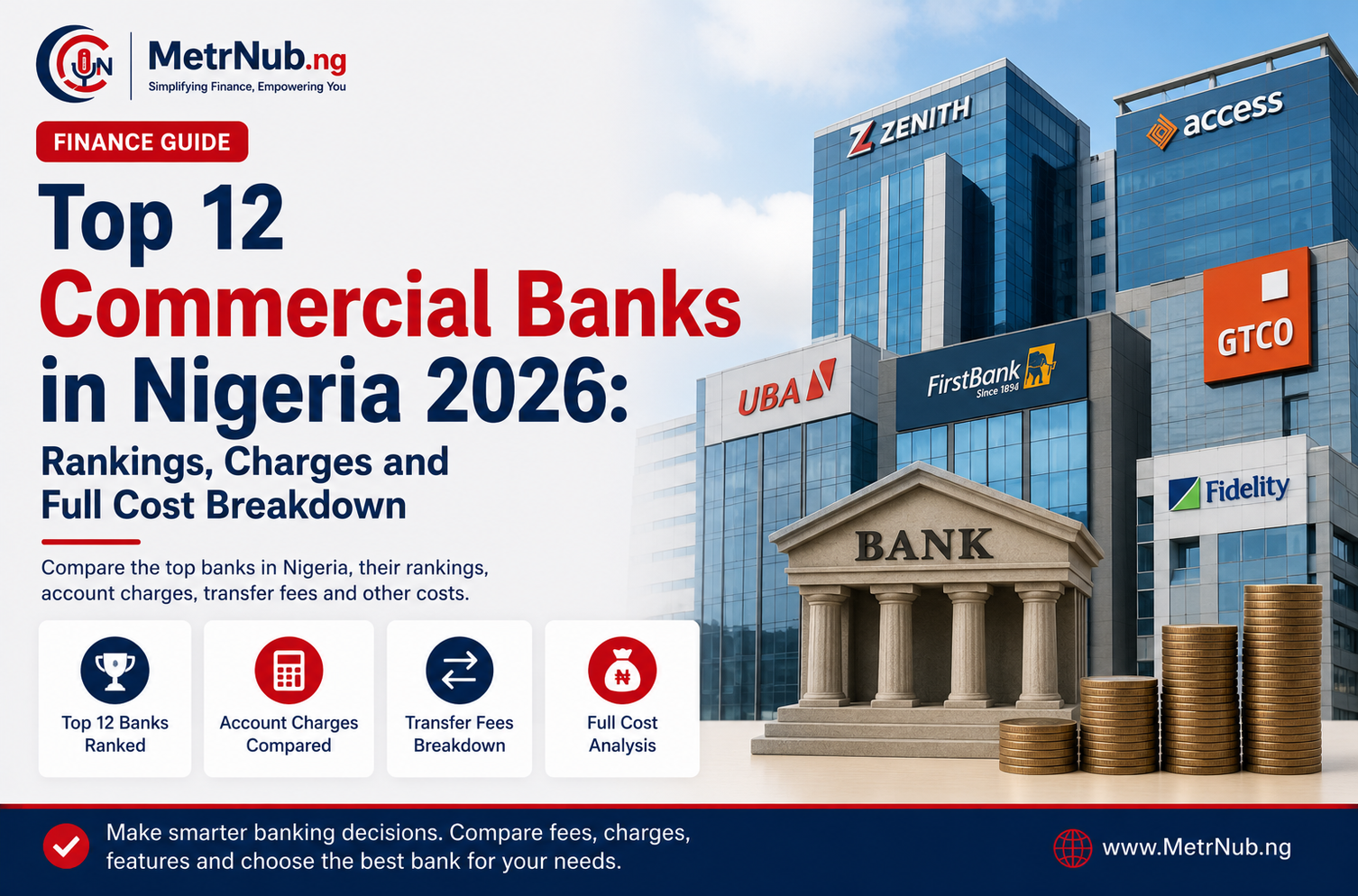
Nigeria's banking sector is one of the most dynamic on the African continent. In 2026, following the Central Bank of Nigeria's recapitalisation exercise that raised over ₦4.65 trillion from 33 financial institutions, the sector has emerged leaner, stronger, and more competitive. The big names have gotten bigger. The mid-tier banks have been forced to sharpen their offerings. And customers — millions of them — are finally beginning to ask harder questions: Which bank holds the most assets? What are they charging me for transfers, ATM withdrawals, and card maintenance? And is my money actually working for me?
This article answers all of that. We rank the top 12 commercial banks in Nigeria by total assets as at Q1 2026, break down what each bank is known for, and then give you a complete, up-to-date breakdown of the charges every Nigerian bank customer needs to understand in 2026 — based on the CBN's revised Guide to Charges by Banks and Other Financial Institutions, which took effect from May 1, 2026.
Let's get into it.
How Nigerian Banks Are Ranked in 2026
The most widely accepted measure of bank size in Nigeria is total assets — the combined value of everything the bank owns or controls, including customer loans, cash holdings, investments, and other financial instruments. A larger asset base generally signals greater financial stability, lending capacity, and operational reach.
The rankings below are drawn from Q1 2026 financial statements filed with the Nigerian Exchange (NGX) and publicly available CBN data. Where Q1 2026 figures were not available, December 2025 audited figures are used and clearly indicated.
Top 12 Commercial Banks in Nigeria — 2026 Rankings by Total Assets
1. Access Holdings Plc — ₦53.43 Trillion
Access Holdings is the undisputed number one bank in Nigeria by total assets in 2026. Led by Group MD/CEO Roosevelt Ogbonna, the group has maintained this position through an aggressive combination of retail network expansion, strong corporate banking relationships, and a deliberate pan-African growth strategy that now spans multiple countries across the continent.
The 2019 merger with Diamond Bank was a watershed moment that catapulted Access into the Tier-1 stratosphere. Today, the bank serves over 60 million customers across more than 20 countries. Its digital banking platforms, robust agency banking network, and deep correspondent banking relationships make it the bank of choice for both multinational corporations and ordinary retail customers.
Best for: Customers who value extensive branch and ATM coverage, diaspora banking, and corporate financial services.
Key strength: Largest customer base and widest geographical footprint of any Nigerian bank.
2. United Bank for Africa (UBA) Plc — ₦33.13 Trillion
United Bank for Africa ranks second in Nigeria's banking league with total assets of ₦33.13 trillion as at Q1 2026. Under the leadership of Group MD/CEO Oliver Alawuba, UBA has built one of the most impressive pan-African banking franchises in the world, with operations in 20 African countries and a growing international presence in the United States, the United Kingdom, France, and the United Arab Emirates.
UBA's asset growth in 2026 has been significantly driven by its subsidiaries across Africa, many of which are top-three banks in their own markets. Its Leo AI chatbot, one of the first banking AI assistants in Africa, has helped the bank attract and retain a tech-savvy customer segment.
Best for: Customers with cross-border financial needs, businesses operating across African markets, and individuals seeking international banking access.
Key strength: Unrivalled pan-African reach and international banking infrastructure.
3. Zenith Bank Plc — ₦32.01 Trillion
Zenith Bank sits in third position with ₦32.01 trillion in total assets, led by Group MD/CEO Adaora Umeoji — one of the most prominent female banking executives in Africa. Zenith has long been regarded as Nigeria's most profitable bank, consistently delivering strong returns to shareholders through disciplined risk management, a lean cost structure, and a focus on high-quality corporate lending.
The bank's corporate banking dominance is complemented by a growing retail franchise, and its foreign exchange capabilities make it the preferred bank for importers, exporters, and businesses with significant FX exposure. In 2026, Zenith's Chinese Yuan (CNY) account offering has positioned it as the leading bank for trade with China — a growing corridor for Nigerian businesses.
Best for: High-volume importers and exporters, corporate banking clients, and customers prioritising financial stability and profitability of their institution.
Key strength: Nigeria's most consistently profitable bank with exceptional risk management.
4. FBN Holdings (First Bank) — ₦26.87 Trillion
Established in 1894, First Bank of Nigeria is the oldest commercial bank in Nigeria and one of the oldest financial institutions in all of West Africa. FBN Holdings, the parent group, held total assets of ₦26.87 trillion in Q1 2026, cementing its position as the fourth largest banking group in the country.
First Bank's greatest competitive advantage is its branch network — no other bank in Nigeria has a deeper physical presence in rural, semi-urban, and underserved communities. Its FirstMobile and FirstOnline digital platforms have helped it modernise while retaining its traditional customer base. The bank also operates one of the most extensive agency banking networks in the country, bringing banking to communities without physical branches.
Best for: Customers in smaller towns and rural areas, long-term account holders, businesses that need broad geographic banking coverage.
Key strength: Nigeria's widest branch and agent network — over 130 years of institutional presence.
5. Guaranty Trust Holding Company (GTCO) — Tier-1 Leader
GTCO, led by Segun Agbaje, remains one of Nigeria's most admired banking brands. While its total assets place it fifth in the overall rankings, GTCO consistently punches above its weight in profitability, efficiency, and digital innovation. Its cost-to-income ratio is among the best in the Nigerian banking industry, and its return on equity has routinely outpaced larger competitors.
GTBank — the commercial banking subsidiary — is iconic for its sleek, no-frills customer experience. Its mobile app is widely regarded as one of the most stable and user-friendly in the Nigerian market. In 2026, GTCO has expanded into payments, funds management, and pension services, evolving from a bank into a full financial services holding company.
Best for: Customers who prioritise a premium digital banking experience, efficient service delivery, and a bank with a strong reputation for not nickel-and-diming customers.
Key strength: Best-in-class digital banking app stability, highest brand trust ratings among Nigerian consumers.
6. Fidelity Bank Plc — ₦11.35 Trillion
Fidelity Bank has made one of the most impressive climbs in recent Nigerian banking history. Under Group MD/CEO Nneka Onyeali-Ikpe, the bank has grown total assets to ₦11.35 trillion and secured an international banking licence in 2026 — a significant regulatory milestone that signals the bank's readiness for global operations.
Fidelity is widely regarded as the "SME Bank of Nigeria." Its products and lending focus are deliberately tailored for small and medium-sized enterprises, making it the most accessible Tier-1 commercial bank for Nigerian entrepreneurs and growing businesses. Its retail banking and diaspora services have also seen strong growth, with dedicated non-resident Nigerian banking products.
Best for: Small and medium-sized business owners, entrepreneurs, diaspora Nigerians, and retail customers seeking a mid-sized bank with strong customer service.
Key strength: Nigeria's premier SME-focused commercial bank with a growing international licence.
7. Stanbic IBTC Holdings Plc — ₦9.70 Trillion
Stanbic IBTC is a unique institution in the Nigerian banking landscape — it is both a commercial bank and a major financial services conglomerate, with subsidiaries covering banking, insurance, pension administration, asset management, stockbroking, and investment banking. The group is a member of Standard Bank Group, Africa's largest bank by assets, and brings international best practices and deep financial expertise to the Nigerian market.
Its total assets of ₦9.70 trillion are anchored by its wealth management and pension businesses, which manage some of the largest retirement funds in Nigeria. For high-net-worth individuals, institutional clients, and corporations requiring complex financial solutions, Stanbic IBTC occupies a category of its own.
Best for: High-net-worth individuals, institutional investors, corporations needing investment banking services, and customers seeking integrated financial planning (banking + pensions + investments).
Key strength: The only Nigerian bank that seamlessly integrates commercial banking with world-class pension and wealth management under one group.
8. FCMB Group Plc — ₦7.54 Trillion
First City Monument Bank (FCMB) has steadily expanded its total assets to ₦7.54 trillion (as at December 2025) through a combination of retail banking growth, SME financing, and digital financial service delivery. Led by Ladi Balogun, the group has diversified across banking, investment banking, and consumer lending.
FCMB is known for its accessible credit products and has been particularly active in the consumer lending space, offering personal loans, salary advance products, and business financing to underserved market segments. Its digital banking platform has seen consistent upgrades, and the group's sub-businesses including FCMB Capital Markets and CSL Stockbrokers round out a diversified financial services offering.
Best for: Individuals seeking accessible consumer loans and personal finance products, SMEs, and customers looking for a mid-tier bank with digital banking tools.
Key strength: One of the most accessible consumer credit and lending platforms in Nigerian commercial banking.
9. Wema Bank Plc — ₦5.23 Trillion
Wema Bank occupies a distinctive position in the Nigerian banking landscape as the creator of ALAT — Nigeria's first fully digital bank. With total assets of ₦5.23 trillion and Group MD/CEO Moruf Oseni at the helm, Wema has leaned heavily into digital innovation to compete with much larger banks, attracting younger, tech-savvy customers who want banking without the branch queues.
ALAT allows users to open accounts entirely online, set automated savings goals, request loans, and manage their finances from a smartphone — no physical branch required. For a bank of Wema's size, this digital-first positioning has been a remarkable differentiator and has significantly grown its retail customer base in recent years.
Best for: Younger customers, digital natives, people who prefer to bank entirely online, and savers who want automated goal-based savings features.
Key strength: Pioneer of fully digital banking in Nigeria through ALAT — best app for automated savings goals.
10. Sterling Bank Plc — ₦4.07 Trillion
Sterling Bank rounds out the top 10 with total assets of ₦4.07 trillion. Founded in 1960 as NAL Bank and restructured through several mergers, Sterling has reinvented itself in recent years with a focus on sector-led banking — concentrating its lending and product development in agriculture, health, education, renewable energy, and real estate (the HEART sectors).
Sterling is also the pioneer of non-interest banking in Nigeria's commercial banking space, through its "Alternative Bank" product, which offers fully Sharia-compliant banking services. This dual positioning — conventional and non-interest banking — gives Sterling a unique edge in a market where a significant Muslim population has historically been underserved by conventional banking.
Best for: Customers in the agriculture, health, and education sectors; Muslims seeking Sharia-compliant banking; SMEs in HEART sectors.
Key strength: Nigeria's leading sector-focused commercial bank and pioneer of mainstream non-interest banking.
11. Ecobank Nigeria — Pan-African Giant
Ecobank Nigeria is a subsidiary of Ecobank Transnational Incorporated (ETI), a pan-African banking conglomerate with operations in 36 African countries — the widest banking footprint on the continent. While its Nigerian subsidiary's standalone assets rank it in the mid-tier, the network power of the broader Ecobank Group makes it an incomparable choice for businesses and individuals with multi-country African banking needs.
Ecobank Nigeria offers strong digital banking services through the Ecobank Mobile App and Omni platform, with particular strength in trade finance, foreign currency transactions, and cross-border transfers within Africa. Its agency banking network continues to expand financial access in underserved communities.
Best for: Businesses operating across multiple African countries, customers who transfer money frequently across Africa, trade finance clients.
Key strength: Widest African banking network — 36 countries — making intra-African transactions faster and cheaper than almost any alternative.
12. Union Bank of Nigeria Plc — Century-Old Institution
Union Bank is one of Nigeria's oldest commercial banks, with roots tracing back to the colonial era before Nigeria's independence. In recent years, the bank underwent significant restructuring and was acquired by Titan Trust Bank, which has refocused its strategy on retail banking, digital financial services, and customer experience improvement.
While Union Bank may not carry the asset weight of the Tier-1 giants, it brings the credibility of over a century of institutional banking history and a loyal, established retail customer base. Its ongoing digital transformation and refreshed brand identity have positioned it as a bank making a genuine comeback in Nigeria's competitive retail banking market.
Best for: Long-standing customers, retail banking clients who value institutional heritage, and customers in communities where Union Bank maintains a significant historical presence.
Key strength: Over 100 years of banking history in Nigeria — one of the most recognisable and trusted brand names in Nigerian banking.
2026 Bank Charges in Nigeria: The Complete CBN-Approved Breakdown
On April 23, 2026, the Central Bank of Nigeria released its updated Guide to Charges by Banks and Other Financial Institutions, which took effect from May 1, 2026. This revised framework replaces the previous guide issued in January 2020 and introduces significant changes that every Nigerian bank customer must understand.
Here is the complete, authoritative breakdown of what you can and cannot be charged in 2026:
ATM Card Issuance and Maintenance Charges
Card issuance/replacement fee: The CBN has increased this from ₦1,000 to ₦1,500 for standard debit and credit cards. This applies when you request a new card or replace a lost, damaged, or expired one. Premium cards (Visa Infinite, Mastercard World, etc.) attract negotiable fees.
Monthly card maintenance fee: Completely abolished. The CBN has scrapped the ₦50 monthly maintenance fee that was previously deducted from naira-denominated debit and credit cards. This is one of the most significant customer-friendly changes in the 2026 guide.
Virtual cards: Issued at no charge. Banks may not charge for the creation or maintenance of virtual cards.
Foreign currency cards: An annual maintenance fee of $10 still applies to foreign currency-denominated cards. This is retained and applies to dollar cards, euro cards, and similar products.
ATM Withdrawal Charges
Your own bank's ATM: Free. No charge applies when you withdraw from an ATM belonging to your own bank.
Another bank's ATM (on-site): ₦100 per ₦20,000 withdrawn. "On-site" means ATMs located within a bank branch or its immediate premises.
Another bank's ATM (off-site): ₦100 per ₦20,000 withdrawn, plus an additional surcharge of up to ₦500 per transaction may be applied by the ATM-owning bank. Crucially, this surcharge must be disclosed to you at the point of the transaction before you confirm the withdrawal.
Electronic Transfer Charges (NEFT, NIP, Mobile Banking)
Electronic transfer fees are one of the areas where the CBN has maintained a tiered structure that protects lower-value transactions:
- Transfers of ₦5,000 and below: Free — no charge applies.
- Transfers between ₦5,001 and ₦50,000: ₦10 per transaction.
- Transfers above ₦50,000: ₦50 per transaction.
These rates are unchanged from the previous framework and remain some of the most affordable interbank transfer fees in Africa. Banks may not charge above these caps regardless of the transfer channel used — whether through USSD, mobile app, internet banking, or over the counter.
Current Account Maintenance Fees
The CBN has retained current account maintenance fees (CAMF) but placed them on a clearly defined phase-out path:
- 2026: Capped at ₦0.5 per mille (₦0.50 for every ₦1,000 in the account balance). This fee remains negotiable between the customer and the bank.
- 2027: Completely eliminated. The CAMF will be reduced to zero by 2027 and may not be charged at all thereafter.
Importantly, the CBN has directed that banks can only apply this charge based on the available account balance. If your account has insufficient funds to cover the fee, the charge must be deferred until funds are available — banks cannot create a negative balance solely from maintenance fees.
Savings accounts: No maintenance fees apply. The CAMF applies only to current accounts.
POS Transaction Charges
This is one of the clearest customer wins in the 2026 guide. POS charges are now fully borne by the merchant, not the customer.
- The Merchant Service Charge (MSC) is set at 0.5% of the transaction value, capped at ₦10,000.
- This MSC is charged to the merchant, not the cardholder.
- Any bank or merchant that attempts to add a surcharge to your POS payment as a customer is acting in violation of CBN regulations.
This means that every time you tap or swipe your card at a shop, supermarket, or restaurant in Nigeria, you should pay exactly the price on the receipt — nothing more.
Transaction Alert Charges
- Email alerts: Must be provided free of charge. No bank may charge for email transaction notifications.
- SMS alerts: May still attract charges, but only on a cost-recovery basis. Banks cannot profit from SMS alert deductions. This means the charge must reflect only what the bank pays the telecom provider for the message, not a marked-up fee.
Account Reactivation and Other Administrative Fees
- Account reactivation: Free. Banks may not charge customers to reactivate a dormant account.
- New fees or products not in the guide: Any new charge not listed in the CBN guide requires prior written approval from the CBN before it can be applied. Banks cannot invent new fees without regulatory authorisation.
- Negotiable charges: Where charges are described as "negotiable" in the guide, banks are required to clearly inform customers of this fact — both at the start of a transaction and whenever relevant. Customers have a right to know when a fee can be discussed or adjusted.
Quick Comparison: 2026 CBN Charges at a Glance
Here is a summary table of the most important charges every Nigerian bank customer should memorise in 2026:
- Card issuance/replacement: ₦1,500 (standard) | Free (virtual card) | $10/year (foreign currency card)
- Card monthly maintenance: Abolished (₦0)
- ATM withdrawal — own bank: Free
- ATM withdrawal — other bank (on-site): ₦100 per ₦20,000
- ATM withdrawal — other bank (off-site): ₦100 per ₦20,000 + up to ₦500 surcharge
- Transfer ₦5,000 and below: Free
- Transfer ₦5,001–₦50,000: ₦10
- Transfer above ₦50,000: ₦50
- POS payment (customer): Free
- POS payment (merchant): 0.5% capped at ₦10,000
- Current account maintenance: Capped at ₦0.5 per mille (eliminated by 2027)
- Email transaction alerts: Free
- SMS transaction alerts: Cost-recovery basis only
- Account reactivation: Free
Which Bank Should You Choose in 2026?
There is no single "best bank" in Nigeria — the right bank depends on what you need it for. Here is a practical guide to help you decide:
If you run a business with cross-border operations in Africa: UBA or Ecobank gives you the widest African network and the best infrastructure for intra-African transfers and trade finance.
If you are an SME owner or entrepreneur: Fidelity Bank's SME-focused products and accessible credit make it the most aligned commercial bank for growing Nigerian businesses. FCMB is also worth considering for consumer and business lending.
If you import or export goods: Zenith Bank's strong correspondent banking relationships, FX capabilities, and CNY account offerings make it the preferred choice for trade finance.
If you prioritise digital banking: GTCO's mobile app leads for stability and user experience. Wema's ALAT platform is best for automated savings and a fully digital-first experience.
If you want Nigeria's largest coverage and branch network: Access Bank and First Bank are unrivalled in terms of physical branch and ATM reach, particularly in smaller towns and rural communities.
If you are a high-net-worth individual or need investment services: Stanbic IBTC's integrated banking, pension, and wealth management offering is in a class of its own for this segment.
If you want non-interest (Sharia-compliant) banking: Sterling Bank's Alternative Bank is the most established non-interest banking product from a mainstream commercial bank in Nigeria.
What the 2026 CBN Reforms Mean for You
The CBN's 2026 banking charges guide represents the most comprehensive attempt in recent years to rebalance the relationship between financial institutions and their customers. For years, Nigerian bank customers have absorbed unexplained deductions, failed digital transactions with fees not reversed, and opaque fee structures that made it impossible to know what they were actually paying for banking.
The elimination of monthly card maintenance fees alone saves a typical multi-account Nigerian customer several thousand naira per year. The capping and eventual abolition of current account maintenance fees by 2027 will benefit millions of business account holders. The removal of customer-side POS charges eliminates one of the most common informal violations seen in retail environments.
However, the increase in ATM card issuance fees from ₦1,000 to ₦1,500 and the expanded off-site ATM surcharge of up to ₦500 are genuine costs that fall disproportionately on Nigerians in underserved communities with limited banking access — where off-site ATMs are often the only option available.
The bottom line is straightforward: know your rights, read this guide, and hold your bank accountable. If you are being charged for something not listed here, or being charged above the CBN-stipulated cap, you have the right to dispute it — and the CBN's Consumer Protection Department exists precisely for that purpose.
Final Thoughts
Nigeria's top 12 commercial banks in 2026 represent a banking sector that, despite its challenges, is growing in sophistication, competition, and reach. From Access Holdings' ₦53.43 trillion asset base to Union Bank's century-long institutional legacy, there is a bank positioned for every type of customer and every financial need.
The key takeaway from the 2026 CBN charges framework is that banking in Nigeria is getting cheaper for everyday transactions — transfers, POS payments, and card maintenance — while the cost of physical infrastructure (card replacement, off-site ATM access) is being adjusted upward. Understanding exactly what you are paying, and why, is the first step to making your money work smarter.
Choose your bank based on your actual financial behavior. Know your CBN-guaranteed rights. And if your bank charges you something that isn't on this list — ask questions.

Comments
Email addresses are never published.