How to Get a Loan in Nigeria Without Collateral — Full Guide (2026)
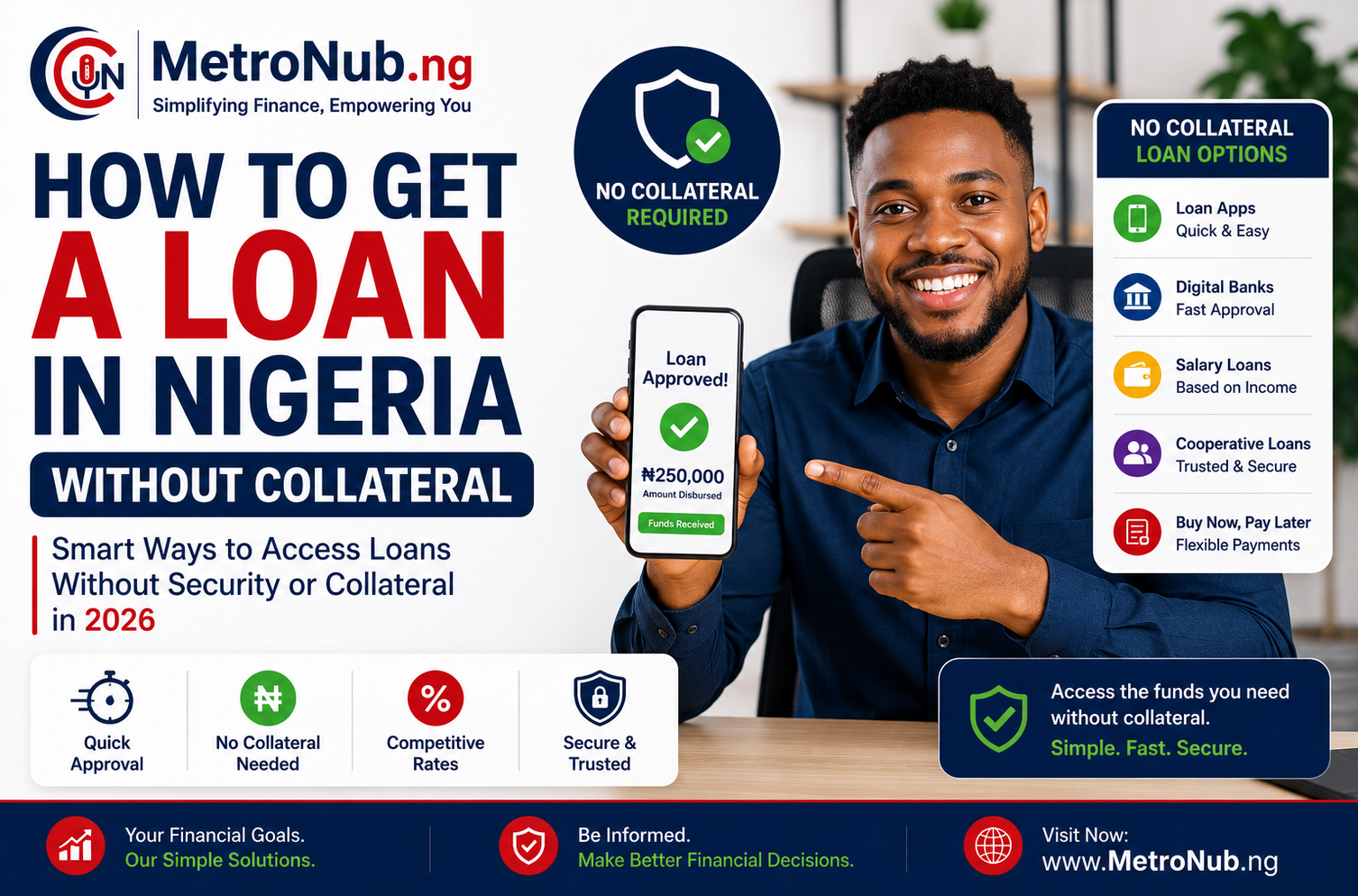
For decades, the word "collateral" was the single biggest roadblock between Nigerians and the credit they needed. Banks wanted land. They wanted a Certificate of Occupancy. They wanted a vehicle, a title deed, a tangible asset they could seize if repayment failed. If you were a market trader in Aba, a fresh graduate in Lagos, a farmer in Benue, or a small business owner anywhere in Nigeria without property to your name, the door to formal credit was essentially closed.
That reality has changed — significantly and permanently. A combination of financial technology, regulatory reform, and genuine competition among lenders has produced a wide landscape of legitimate, collateral-free loan options in Nigeria. Today, your creditworthiness is assessed through your income consistency, account behaviour, credit history, and digital financial footprint — not by what property you own.
This guide covers every legitimate route available to Nigerians who need a loan without collateral in 2025 and 2026. It covers digital loan apps, bank products, government-backed schemes, cooperative societies, and development finance institutions — what each one offers, who qualifies, what the real requirements are, and how to apply. More importantly, it tells you what to watch out for, because the absence of collateral requirements does not mean the absence of risk.
What Does "No Collateral" Actually Mean?
Before diving into the options, it is worth being precise about what collateral-free lending means — because a common misconception leads many borrowers into trouble.
Collateral, in the traditional banking sense, refers to a physical asset pledged as security against a loan. If you cannot repay, the lender takes the asset. When a lender says "no collateral required," they are saying they will not ask you to pledge land, property, a vehicle, or equipment before approving your loan.
What they are not saying is that there is no consequence for non-repayment. No-collateral loans are not risk-free for the borrower. When physical assets are removed from the equation, lenders use other mechanisms to protect their exposure: salary deductions directly from payroll, credit bureau blacklisting, BVN-linked debt recovery, legal action for larger amounts, and for digital lenders, platform-level account restrictions. These consequences are real, even without a piece of land changing hands. Borrow with this understanding firmly in mind.
What Lenders Look at Instead of Collateral
When a lender removes the physical asset requirement, they compensate with a deeper look at your financial behaviour. Understanding what they examine helps you position yourself as a strong borrower before you even apply.
Income consistency. Whether you are employed or self-employed, lenders want to see that money comes into your account regularly and predictably. A salary that arrives on the same date every month is gold. For business owners, consistent monthly deposits — even if the amounts vary — demonstrate active trading and cash flow.
Account transaction history. Lenders, especially banks, will review three to six months of your bank statement. They are looking at how you manage money — whether you overdraw constantly, whether you save any portion of what you earn, whether there are patterns of financial discipline or financial stress.
Credit bureau records. Nigeria has three licensed credit bureaus: CRC Credit Bureau, FirstCentral Credit Bureau, and CreditRegistry. When you borrow and repay responsibly, that gets recorded. When you default, that gets recorded too. A clean credit bureau report is increasingly your most valuable asset when approaching any formal lender without collateral. Defaulting on a ₦20,000 digital loan today can close the door to a ₦5,000,000 bank loan in three years.
BVN-linked history. Your BVN connects your identity across every financial institution in Nigeria. Lenders can see, through the NIBSS infrastructure, whether you have active loans elsewhere, how many loan applications you have made recently, and whether you have any unresolved defaults. Multiple simultaneous active loans from different platforms is a red flag for any new lender.
Employment and employer standing. For salary-based loans, the reputation and financial stability of your employer matters. A civil servant whose salary is paid by the government is considered lower-risk than an employee of a small, unregistered private company, even if their salaries are the same. Banks often maintain lists of approved employers for their loan products.
Route 1 — Digital Loan Apps (Fast, No Collateral, Available to Everyone)
The most accessible entry point for collateral-free borrowing in Nigeria is the loan app. As covered in detail in our guide to the best loan apps in Nigeria, platforms like FairMoney, Carbon, Branch, Palmcredit, Renmoney, QuickCheck, and EaseMoni all offer unsecured loans using BVN-based identity verification and credit scoring algorithms in place of traditional asset requirements.
Who This Works For
Loan apps are broadly accessible. You do not need a salary account with a specific bank. You do not need an employer letter. You do not need to have any prior borrowing history — though having one helps. If you have a BVN, an active bank account, a smartphone, and a consistent source of income (formal or informal), you can access a loan app.
What You Can Realistically Borrow
For a first-time user, loan apps typically start you at small amounts — ₦2,000 to ₦30,000 — with short repayment tenures of 7 to 30 days. This is deliberate. The app needs to test your repayment behaviour before extending trust. If you repay on time consistently, limits increase significantly — often reaching ₦500,000 to ₦3,000,000 for established users on platforms like FairMoney and Carbon.
The Real Cost of Loan App Borrowing
This is the part that catches people. Monthly interest rates on loan apps range from 2% to 30% per month depending on the platform, your credit profile, and the loan tenure. At the higher end, a ₦50,000 loan for 30 days at 15% monthly interest costs you ₦7,500 in interest alone — a 15% return on cash in thirty days. For a short-term emergency, that may be acceptable. As a rolling habit, it becomes financially damaging very quickly.
Always check the total repayment figure displayed in the app before you accept any offer. Under the DEON Consumer Lending Regulations 2025, registered lenders are required to show you this figure upfront. If it is not clearly displayed before you tap "Accept," that is a red flag.
How to Apply
Download the app from the official Google Play Store or Apple App Store. Register with your BVN and phone number. Complete any additional identity verification steps requested. Submit a loan request, review the offer and total repayment amount carefully, then accept if the terms are workable. Disbursement for most apps happens within minutes.
Route 2 — Bank Salary Advance and Quick Credit Products
If you are a salary earner with your account at one of Nigeria's major commercial banks, you likely have access to a collateral-free loan product you may not know exists — or may not have fully explored.
Nigeria's tier-one banks have all developed instant, no-collateral loan products designed specifically for salary earners. These are typically cheaper than loan apps and are repaid automatically from your salary account — which makes the process nearly friction-free once you're set up.
GTBank Quick Credit and Salary Advance
GTBank's Quick Credit offers between ₦10,000 and ₦5,000,000 with no collateral required and no paperwork. Applications are made entirely through the GTWorld mobile app or by dialling *737*8*2#. Repayment periods run from 6 to 12 months, and approval is often instant. You need a minimum monthly income of ₦20,000 flowing into your GTBank account, and a clean credit history.
GTBank's Salary Advance is a shorter-term product: up to 50% of your net monthly salary for 30 days, renewable monthly, with no collateral. Minimum salary is ₦25,000 for public sector workers and ₦50,000 for private sector employees. Apply via the GTWorld app or by dialling *737*6*1#.
Access Bank Payday Loan
Access Bank's Payday Loan allows customers to borrow up to 75% of their net monthly salary with no collateral and no paperwork. It is available to both Access Bank account holders and non-account holders with BVN-linked accounts showing regular salary inflows. Loan tenure is 30 to 90 days. Apply via the Access Bank mobile app or dial *901*11*1#.
Zenith Bank Salary Advance
Zenith Bank's Salary Advance offers up to 60% of your net monthly salary as a revolving credit facility at an interest rate of approximately 26% per annum (2.16% per month). Your salary must be domiciled with Zenith Bank. The loan includes an indemnity clause that allows Zenith to recover the debt from any Nigerian bank account tied to your BVN if repayment fails — a significant consequence worth understanding before you apply.
First Bank FirstAdvance
First Bank offers FirstAdvance, a digital salary advance product available through the FirstMobile app or USSD code *894#. It provides up to 50% of your net monthly salary, capped at ₦500,000, with a 30-day repayment period. No collateral, no documentation — just an active First Bank salary account with at least three months of salary history.
Who Bank Products Work Best For
These products are excellent for salary earners who already bank with these institutions. The rates are generally lower than app-based lenders, automatic repayment from salary eliminates the risk of forgetting a payment, and there is no risk of the predatory practices that characterise unregistered loan apps. The main limitation is that your salary must typically be domiciled with the lending bank — you cannot access GTBank's salary advance if your salary goes into an Access Bank account.
Route 3 — Microfinance Banks (For Informal Sector Workers and Small Businesses)
Microfinance banks (MFBs) occupy a crucial middle ground in Nigeria's lending landscape. They are regulated by the CBN, operate with formal consumer protections, and are specifically designed to serve customers who fall outside the typical profile of commercial bank borrowers — market traders, artisans, small business owners, rural workers, and informal sector earners.
Unlike commercial banks, most MFBs do not require landed property as collateral. Instead, they often use group lending (where a group of borrowers collectively guarantee each other's loans), income verification from business records or cash flow analysis, and the strength of your banking relationship with the institution itself as the basis for lending.
LAPO Microfinance Bank is one of the most widely known and accessible MFBs in Nigeria, with branches across all 36 states. It offers group and individual loans to traders, farmers, and small business owners, typically with flexible repayment schedules tied to the borrower's business cycle rather than a fixed monthly calendar.
AB Microfinance Bank focuses on urban small businesses and offers individual business loans without requiring property collateral, using your trading records, account statements, and business cash flow as the primary assessment criteria.
NIRSAL Microfinance Bank is the government-linked MFB that channels several CBN intervention schemes, including AGSMEIS. If you are applying for government-backed loans for agriculture or SMEs, NIRSAL MFB is one of your primary entry points.
To approach a microfinance bank for a no-collateral loan, you will typically need: a valid ID, your BVN, three to six months of bank statements, evidence of your business or income source (receipts, invoices, business name registration where applicable), passport photographs, and proof of address. Processing times are longer than a digital app but significantly shorter than a commercial bank — typically five to ten working days.
Route 4 — Cooperative Societies (Cheapest Option, Most Overlooked)
If there is one collateral-free borrowing channel that is consistently underutilised by Nigerians, it is the cooperative society. And it is arguably the single best option available for people who qualify.
A cooperative society is a member-owned financial group in which members contribute regular savings and can access loans from the pooled funds, typically at interest rates of 5% to 10% per annum — a fraction of what any loan app or commercial bank charges. The loan is guaranteed not by a physical asset but by your membership contribution, your savings history within the cooperative, and in many cases the collective guarantee of fellow members.
Cooperatives exist in virtually every workplace, religious organisation, market association, alumni group, and community in Nigeria. If you are employed, your workplace almost certainly has a staff cooperative society. If you are self-employed, your trade association or market union likely has one. If you are a church or mosque member, many religious bodies run thrift and cooperative schemes for members.
The borrowing limits from cooperatives are tied to your contribution history — typically you can borrow two to three times your accumulated savings. The repayment is structured and manageable, deducted in instalments over an agreed period. There are no predatory charges, no contact shaming, no hidden fees. And unlike a loan app that disappears next year, a cooperative society is a long-term financial relationship that compounds in value the longer you participate.
How to join a cooperative: Ask your HR department, union, or religious body whether a cooperative exists and how to join. Membership typically involves a registration fee and a commitment to regular monthly contributions. Most cooperatives require three to six months of contribution history before you can access a loan.
Route 5 — Government-Backed Loan Schemes (For Businesses and Entrepreneurs)
For business owners and entrepreneurs specifically, several government-backed loan schemes exist in Nigeria that either explicitly waive collateral requirements or replace them with alternative guarantees. These loans are typically offered at below-market interest rates — some as low as 9% per annum — making them some of the most affordable credit available in the country.
AGSMEIS — Agri-Business / SME Investment Scheme
The AGSMEIS (Agri-Business/Small and Medium Enterprise Investment Scheme) is a CBN-backed fund managed through NIRSAL Microfinance Bank. It targets agriculture and SMEs in manufacturing, services, and related sectors. Loans are available at an interest rate of 5% per annum with a maximum loan amount of ₦10,000,000 for individuals and ₦100,000,000 for cooperatives.
There is no property collateral requirement. Instead, applicants must complete approved entrepreneurship training from a CBN or NIRSAL-approved Entrepreneur Development Institute (EDI) and submit a viable business plan. The training requirement is a meaningful commitment — typically three to five days — but it also means the fund reaches people who have invested time in preparing to use the money productively.
CBN Creative Industry Financing Initiative (CIFI)
If you work in Nigeria's creative sector — film production, music, fashion, software development, or information technology — the CIFI is worth knowing about. It is part of the CBN's broader financial inclusion strategy and provides credit to creative industry practitioners at an interest rate capped at 9% per annum. Loan amounts go up to ₦500,000,000 for larger productions, and the scheme explicitly addresses the fact that creative workers rarely have physical assets to pledge as collateral.
Development Bank of Nigeria (DBN)
The Development Bank of Nigeria (DBN) does not lend directly to individuals or small businesses — it provides long-term funding and credit guarantees to participating commercial banks, microfinance banks, and fintech lenders, which then on-lend to qualifying SMEs. A $500 million World Bank-backed programme approved in December 2025 is expected to significantly expand DBN's credit reach through its partner financial intermediaries in 2026.
If you are applying for an SME loan through a participating commercial bank or MFB, ask specifically whether they are a DBN partner institution — this may give you access to better terms and longer repayment periods.
SMEDAN (Small and Medium Enterprises Development Agency of Nigeria)
SMEDAN does not lend directly, but its Credit Information Portal at smedan.gov.ng is one of the most useful free resources available to Nigerian business owners seeking credit. You can search for loans from banks and government programmes that match your sector, loan amount, and documentation level. Registering with SMEDAN and obtaining a SUIN (SMEDAN Unique Identification Number) also makes you eligible for several dedicated loan programmes that SMEDAN coordinates with partner banks.
As of December 2025, SMEDAN has also announced plans to establish its own dedicated microfinance bank in 2026, pending CBN approval — a move that would give it a direct lending arm for the first time.
Route 6 — Peer-to-Peer Lending and Salary-Linked Fintech Products
Beyond the categories above, a growing category of Nigeria-based fintech lenders offer collateral-free credit through salary linking, invoice financing, and employer integration.
Aella Credit pioneered employer-integrated lending in Nigeria — by verifying your employment directly with your employer and having repayment deducted from salary at source, it can offer lower interest rates than standard app lending without requiring any collateral. Businesses can also list themselves as Aella employer partners, enabling their staff to access better credit terms.
Creditville and similar platforms offer personal and SME loans where the primary collateral substitute is a clean credit bureau report and verifiable income — no property, no guarantor, no physical asset required.
For business owners specifically, invoice financing — where you borrow against the value of unpaid customer invoices — is a growing collateral-free option. The invoice itself serves as the security. Several Nigerian fintechs and merchant banks now offer this product, particularly for businesses in manufacturing, distribution, and services with corporate or government clients.
How to Improve Your Chances of Getting Approved Without Collateral
Understanding the options is one thing. Being positioned to actually get approved is another. Here are the practical steps that make the difference between an approval and a rejection when collateral is not on the table.
Maintain a clean credit bureau record. Check your credit report before applying for any loan. You can request a free credit report from CRC Credit Bureau, FirstCentral Credit Bureau, or CreditRegistry. Resolve any outstanding defaults, even small ones, before making a new loan application. Multiple default flags on your record will close most doors regardless of how good your current income looks.
Keep your bank account active and healthy. Salary-linked and bank-based loans are assessed on your account behaviour. An account with regular inflows, controlled spending, and no pattern of being overdrawn tells a lender everything they need to know. Sporadic inflows, constant zero balance, or frequent failed debit attempts tell a very different story.
Do not apply for multiple loans simultaneously. Multiple loan applications within a short period show up on your BVN-linked financial profile and signal desperation or financial distress to lenders. Decide on the most appropriate lending route, apply there, and wait for a response before approaching another option.
Start small and build. If you are a new borrower with no credit history, start with a small loan you can easily repay — even if you don't urgently need the full amount you could theoretically qualify for. Repaying on time builds your credit profile across all bureaus, which directly increases your limit and improves your terms on the next application.
Formalise your income documentation. For self-employed borrowers, having six months of bank statements that clearly show business income and consistent account activity is worth more than any physical document. If you currently operate primarily in cash, start routing your business transactions through your bank account now — your future self will thank you at the next loan application.
Register your business. For entrepreneurs seeking business loans, a CAC (Corporate Affairs Commission) registration significantly improves your standing. It demonstrates seriousness, gives you access to a business bank account, and makes you eligible for programmes that are specifically limited to registered businesses. CAC registration for a Business Name costs under ₦10,000 and can be done online at pre.cac.gov.ng.
Risks to Understand Before You Borrow Without Collateral
Collateral-free borrowing is a genuine opportunity. It is also, in the wrong hands or through the wrong channels, a genuine risk. These are the dangers worth naming clearly.
High interest rates from unregistered lenders. The loan apps with the loudest advertising and the easiest approval processes are frequently the most expensive and the least compliant. Always verify registration on the FCCPC register at fccpc.gov.ng before downloading any lending app. Unregistered lenders are not bound by interest rate guidelines, consumer protection rules, or the DEON Regulations 2025.
The debt spiral. The convenience of no-collateral, instant loans makes it dangerously easy to borrow repeatedly without a clear repayment plan. Taking a new loan to repay an old one is the entry point of a debt spiral. If you find yourself in this pattern, the problem is a budget problem — not a loan problem. Address the former, not the latter.
Credit bureau damage. A single default on a loan in Nigeria — even a ₦5,000 loan app debt — can appear on your credit bureau report and remain there for years. During that period, your ability to access formal credit from banks, microfinance institutions, and regulated lenders is significantly diminished. The short-term pain of repaying a difficult loan is almost always smaller than the long-term cost of a damaged credit record.
Automatic salary deductions. Bank salary advance and employer-linked loans are repaid automatically from your account. If your salary is delayed in a given month, the automatic deduction can still fire — leaving your account empty or triggering an overdraft. Know your bank's policy on this before you accept the loan.
Final Thoughts
Getting a loan in Nigeria without collateral is not only possible in 2025 and 2026 — it is, for most borrowers, the default way that credit now works. The collateral barrier has been substantially dismantled through digital lending technology, CBN policy reform, and genuine market competition among lenders who want your business.
What has replaced the collateral requirement is your financial behaviour. Your account history, your credit bureau record, your income consistency, your repayment discipline — these are now the assets that determine your access to credit. They are not physical assets you either have or don't. They are habits and patterns that you build over time, and they compound in value the more deliberately you manage them.
Choose your lending route based on your situation: loan apps for quick, small-to-medium amounts; bank salary products for employed workers who need convenience and lower rates; microfinance banks for informal sector workers and small business owners; cooperative societies for the most affordable long-term borrowing; government-backed schemes for entrepreneurs and agricultural businesses who can commit to the application process.
Whichever route you choose — borrow with a clear repayment plan, from a registered and regulated lender, for a specific and productive purpose. That combination turns credit into a tool. Without it, the same credit becomes a problem.
Always verify a lender's registration status with the FCCPC at fccpc.gov.ng and CBN licensing at cbn.gov.ng before submitting any application or sharing personal financial information. Interest rates and loan terms described in this guide reflect publicly available information as of 2025/2026 and may vary based on individual credit profiles.

Comments
Email addresses are never published.