How to Open a Bank Account in Nigeria: Step-by-Step Guide for Beginners.
By MetroNub Staff
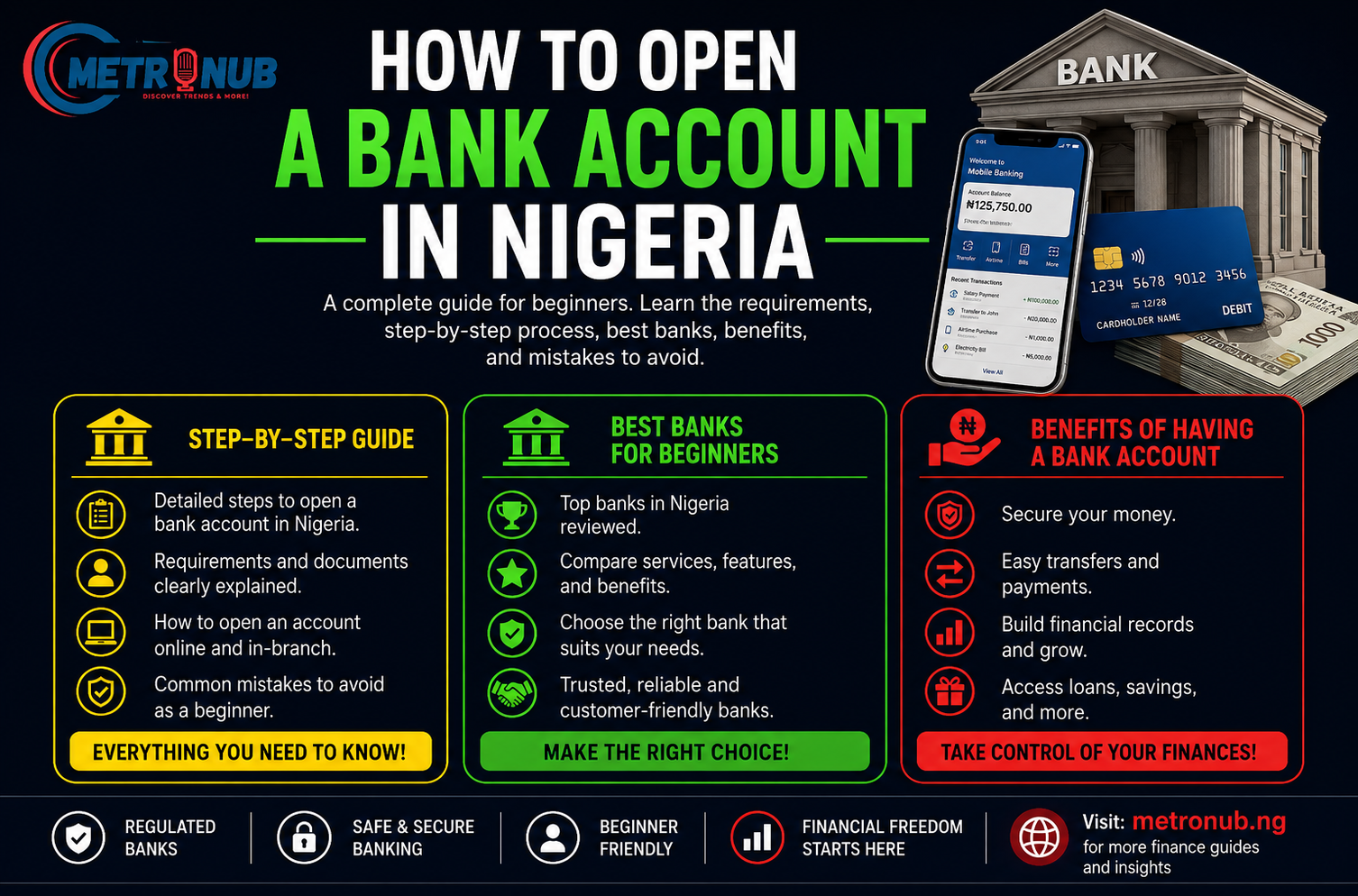 Step by step on how to ope a Bank account
Opening a bank account is one of the most important financial steps anyone can take. Whether you are a student, employee, entrepreneur, freelancer, or business owner, having a bank account gives you access to essential financial services that make managing money easier, safer, and more convenient.
In Nigeria, banking has become more accessible than ever before. With the growth of digital banking, mobile applications, internet banking platforms, and simplified account-opening procedures, individuals can now create and manage bank accounts without spending long hours at a physical branch. Many Nigerian banks even allow customers to begin the registration process online and complete verification within a short period.
Despite these improvements, many people still feel confused about the account-opening process. Questions such as "What documents do I need?", "Which bank should I choose?", "Can I open an account online?", and "How long does the process take?" are common among first-time applicants. For someone who has never interacted with a bank before, the process may appear complicated or intimidating.
The good news is that opening a bank account in Nigeria is generally straightforward when you understand the requirements and the steps involved. Most banks require basic personal information, a valid means of identification, a Bank Verification Number (BVN), and proof of address. Once these requirements are met, applicants can usually complete the process within a relatively short time.
A bank account does much more than simply store money. It enables individuals to receive salaries, make transfers, pay bills, save for future goals, access loans, use debit cards, and perform countless financial transactions securely. In today's increasingly digital economy, having a functional bank account is often necessary for both personal and professional activities.
Choosing the right account is equally important. Different banks offer various account types, features, charges, and digital banking services. Understanding these options helps individuals select an account that aligns with their financial needs and lifestyle.
This guide provides a complete step-by-step explanation of how to open a bank account in Nigeria. You will learn about the different types of accounts available, the documents required, how to open an account online or at a branch, common mistakes to avoid, and practical tips that can help make the process smooth and successful. By the end of this article, you will have the knowledge and confidence needed to open and manage a bank account effectively in Nigeria.
Types of Bank Accounts in Nigeria
Before opening a bank account in Nigeria, it is important to understand the different account options available. Banks offer various types of accounts to meet different financial needs, whether you want to save money, carry out regular transactions, receive foreign payments, or manage business finances. Choosing the right account can improve your banking experience and help you achieve your financial goals more effectively.
Although specific features may differ from one bank to another, most Nigerian banks offer savings accounts, current accounts, domiciliary accounts, student accounts, and fixed deposit accounts. Each account serves a unique purpose and is designed for a particular category of users.
Savings Account
A savings account is the most popular type of bank account in Nigeria. It is designed for individuals who want a safe place to keep their money while earning interest on their deposits. This account is suitable for students, salary earners, freelancers, entrepreneurs, and anyone looking to build a savings habit.
Most first-time account holders choose a savings account because it is easy to open and comes with essential banking services such as ATM cards, mobile banking, internet banking, and fund transfers.
- Suitable for personal savings.
- Allows deposits and withdrawals.
- Usually earns interest on account balances.
- Comes with a debit card.
- Supports mobile and internet banking services.
Current Account
A current account is designed for individuals and businesses that perform frequent financial transactions. Unlike a savings account, a current account focuses on convenience and transaction flexibility rather than interest earnings.
Business owners, companies, contractors, and professionals often use current accounts because they provide higher transaction limits and may include cheque book facilities.
- Ideal for business transactions.
- Supports frequent deposits and withdrawals.
- May include cheque book services.
- Offers higher transaction limits.
- Suitable for companies and entrepreneurs.
Domiciliary Account
A domiciliary account allows customers to receive, save, and send money in foreign currencies such as United States Dollars (USD), British Pounds (GBP), and Euros (EUR). This account is particularly useful for freelancers, exporters, importers, remote workers, and individuals who receive payments from abroad.
With a domiciliary account, customers can hold foreign currency without immediately converting it to Naira, giving them greater flexibility when managing international transactions.
- Supports foreign currency transactions.
- Useful for receiving international payments.
- Can hold multiple foreign currencies depending on the bank.
- Suitable for freelancers and international businesses.
- Provides access to global banking services.
Student Account
Many Nigerian banks offer student accounts specifically designed for young people in secondary schools, colleges, and universities. These accounts usually have simplified requirements and are intended to encourage financial responsibility at an early age.
Student accounts often provide access to digital banking services while maintaining low account maintenance requirements.
- Designed specifically for students.
- Easy to open with minimal documentation.
- Supports saving and everyday transactions.
- Encourages financial discipline.
- May have lower banking charges.
Fixed Deposit Account
A fixed deposit account is designed for individuals who want to invest their money for a specific period while earning a higher interest rate than a traditional savings account. Funds deposited into this account are usually locked for an agreed duration.
This account is commonly used by people looking for stable and predictable returns without taking significant investment risks.
- Offers higher interest rates.
- Suitable for medium-term and long-term savings goals.
- Provides predictable returns.
- Requires funds to remain invested for a fixed period.
- Ideal for growing idle funds.
Understanding these account types can help you choose the banking option that best matches your financial needs. For most beginners, a savings account is often the best starting point because it combines simplicity, accessibility, and essential banking features. However, individuals with specific requirements such as business transactions or foreign payments may benefit more from a current account or domiciliary account.
Requirements for Opening a Bank Account in Nigeria
Before a bank can open an account for you, certain documents and personal information must be provided. These requirements help banks verify your identity, comply with financial regulations, and protect customers from fraud. While requirements may vary slightly between banks, most Nigerian financial institutions follow similar account-opening procedures.
Having all the necessary documents ready before starting the application process can make account opening faster and more convenient. Whether you choose to visit a bank branch or apply through a digital platform, meeting these requirements is an important step toward successfully opening an account.
Bank Verification Number (BVN)
The Bank Verification Number, commonly known as BVN, is one of the most important requirements for opening a bank account in Nigeria. The BVN serves as a unique identity number linked to your biometric information and banking records.
It helps banks verify customer identities, reduce fraudulent activities, and improve security across the Nigerian banking system. If you do not already have a BVN, you may need to enroll at a bank branch before completing your account registration.
- Provides a unique banking identity.
- Helps prevent identity theft and fraud.
- Links multiple bank accounts to one customer profile.
- Required by most Nigerian banks.
Valid Means of Identification
Banks require customers to present an acceptable means of identification to confirm their identity. The identification document must usually be valid and contain accurate personal information that matches the details provided during registration.
- National Identification Number (NIN) slip or card.
- National ID card.
- International passport.
- Driver's license.
- Permanent Voter's Card (PVC).
Providing a valid means of identification helps banks comply with Know Your Customer (KYC) regulations and maintain secure banking operations.
Passport Photograph
Many banks require recent passport photographs as part of the account-opening process. These photographs are used for customer records and identity verification.
Although some digital account-opening platforms capture customer photographs electronically, certain banks may still request physical passport photographs, especially during branch registration.
- Must be recent and clear.
- Should accurately reflect your current appearance.
- May be required in physical or digital format.
Proof of Address
Banks often request proof of residential address to confirm where a customer lives. This information helps improve customer verification and supports regulatory compliance.
The address provided during registration should match the information contained in any supporting documents submitted.
- Utility bill.
- Tenancy agreement.
- Official government correspondence.
- Bank-issued address verification documents where applicable.
Personal Information
Applicants must provide accurate personal information during registration. Banks use this information to create customer profiles and maintain account records.
- Full name.
- Date of birth.
- Phone number.
- Email address.
- Residential address.
- Occupation.
- Next of kin details.
Providing correct information is important because inaccurate details may delay account approval or create problems when accessing banking services in the future.
Initial Deposit Requirement
Some banks may require a minimum opening deposit depending on the type of account being opened. However, many modern Nigerian banks and digital banking platforms now allow customers to open accounts with little or no initial deposit.
It is advisable to check the specific requirements of your preferred bank before beginning the registration process.
- Requirements vary between banks.
- Some accounts have no minimum opening balance.
- Business and specialized accounts may require larger deposits.
Preparing these requirements in advance can make the account-opening process smoother and faster. Once you have your BVN, identification documents, personal information, and any additional requirements requested by your chosen bank, you will be ready to proceed with the account registration process.
Step-by-Step Process to Open a Bank Account in Nigeria
Opening a bank account in Nigeria can be simple and quick if you follow the proper steps. Whether you choose to open the account at a physical branch or through an online platform, understanding the process beforehand will save time and prevent mistakes. Below is a detailed step-by-step guide to help beginners successfully open a bank account.
Step 1: Choose the Right Bank and Account Type
The first step is to select a bank that meets your financial needs and goals. Consider factors such as branch accessibility, mobile and internet banking services, fees, interest rates, customer support, and account features.
Next, choose the type of account that suits you best. For beginners, a savings account is usually ideal, while business owners may prefer a current account, and those dealing with foreign currencies may need a domiciliary account.
- Compare banks for convenience and services.
- Identify the account type that aligns with your financial needs.
- Consider digital banking options for ease of access.
Step 2: Prepare Required Documents
Before visiting a bank branch or starting an online application, gather all necessary documents. This usually includes your Bank Verification Number (BVN), valid means of identification, passport photograph, proof of address, and personal information.
Having these documents ready ensures a smooth registration process and reduces the likelihood of delays.
- BVN
- National ID, Passport, Driver's License, or PVC
- Recent passport photograph
- Proof of address (utility bill, tenancy agreement, etc.)
- Personal details (full name, date of birth, phone number, etc.)
Step 3: Visit a Bank Branch or Use Online Banking
You can open a bank account either by visiting a physical bank branch or using the bank’s online platform. For branch registration, approach a customer service representative who will guide you through filling out an account application form.
For online account opening, most banks provide a mobile app or web portal where you can register, upload your documents, and complete the verification process digitally.
- Branch registration: Fill out an application form and submit documents in person.
- Online registration: Download the bank’s app or visit their website, fill out the form, and upload documents.
- Digital verification may include selfie capture or video verification.
Step 4: Submit Your Application and Wait for Approval
After submitting your application and documents, the bank will verify your information. This process may take a few hours to a few days depending on the bank and whether you applied online or in person.
Once your application is approved, the bank will notify you, and your account will be ready for use.
- Ensure all documents are accurate to avoid delays.
- Track application status if applying online.
- Expect verification of personal and BVN information.
Step 5: Fund Your Account
Some banks require an initial deposit to activate the account. Deposit the required amount using cash, transfer, or mobile payment to start using your account fully. Even if the bank does not require an initial deposit, it is advisable to fund your account to begin transactions immediately.
- Deposit the minimum required balance if applicable.
- Keep a record of your first deposit for verification.
- Start using your account for withdrawals, transfers, and payments.
Step 6: Receive Account Details and Banking Tools
After approval, the bank will provide your account number, debit card, cheque book (if applicable), and online banking credentials. Make sure to set up your mobile banking app and secure your login information properly.
- Collect your account number and debit card.
- Activate online and mobile banking accounts.
- Keep your credentials secure to prevent unauthorized access.
Following these steps carefully ensures that you can open a bank account in Nigeria quickly and efficiently, whether for personal savings, business transactions, or managing foreign currency funds. Proper preparation, accurate documentation, and understanding each step are key to a smooth banking experience.
How to Open a Bank Account Online in Nigeria
Digital banking has transformed the way people access financial services in Nigeria. Today, many banks allow customers to open accounts directly from their smartphones, tablets, or computers visiting a physical branch. This process is faster, more convenient, and ideal for individuals who prefer managing their finances digitally.
Online account opening typically involves completing a registration form, verifying your identity, and activating your account through the bank's digital platform. Although specific procedures may differ among banks, the overall process remains similar.
Download the Bank's Mobile App or Visit the Official Website
The first step is to access the bank's digital account-opening platform. Most Nigerian banks provide mobile applications and secure websites that allow new customers to begin the registration process.
Ensure that you use the official application or website to protect your personal information and avoid fraudulent platforms.
- Download the official banking app.
- Visit the bank's official website.
- Ensure the platform is secure before submitting information.
Select the Account Type
After accessing the platform, you will be asked to choose the type of account you want to open. Most users select a savings account, but options such as current accounts and domiciliary accounts may also be available.
Selecting the correct account type ensures that the account features align with your financial needs.
- Savings account.
- Current account.
- Domiciliary account.
- Specialized account options where available.
Provide Personal Information
The registration form will require basic personal information. It is important to provide accurate details because the information will be used for identity verification and account creation.
- Full name.
- Date of birth.
- Phone number.
- Email address.
- Residential address.
- Occupation.
Incorrect information may delay approval or create challenges when accessing banking services in the future.
Verify Your BVN and Identity
Most banks require applicants to provide their Bank Verification Number (BVN) during registration. The BVN helps the bank retrieve and verify your identity information.
Some banks may also request a photograph, selfie verification, National Identification Number (NIN), or a scanned copy of an approved identification document.
- Enter your BVN correctly.
- Upload a valid means of identification if requested.
- Complete any selfie or biometric verification process.
Upload Supporting Documents
Depending on the bank and account type, you may be asked to upload supporting documents. These documents help the bank confirm your identity and residential address.
- Passport photograph.
- National ID card.
- International passport.
- Driver's license.
- Proof of address.
Ensure that uploaded documents are clear, readable, and up to date.
Submit the Application
After completing all required sections, review the information carefully before submitting the application. Double-check names, phone numbers, BVN details, and uploaded documents to avoid errors.
Once submitted, the bank will begin the verification process.
- Review all entered information.
- Confirm document uploads.
- Submit the application for processing.
Receive Your Account Number
After successful verification, the bank will create your account and provide your account number. In many cases, customers receive their account details within minutes, while some applications may require additional review.
You can then log in to the mobile banking app, fund the account, perform transfers, pay bills, and access other banking services.
- Receive account details.
- Activate mobile banking services.
- Fund the account.
- Start using banking features immediately.
Opening a bank account online is one of the easiest ways to access financial services in Nigeria. With a smartphone, internet connection, BVN, and the required documents, most individuals can complete the process quickly without visiting a bank branch.
Best Banks in Nigeria for Beginners
Choosing the right bank is an important decision, especially for first-time account holders. While most Nigerian banks offer similar core services such as savings accounts, transfers, debit cards, and mobile banking, some institutions provide a better experience for beginners through user-friendly applications, extensive branch networks, reliable customer support, and modern digital banking features.
The best bank for you will depend on your financial goals, preferred banking channels, location, and the services you intend to use most often. Below are some of the popular options that many Nigerians consider when opening their first bank account.
Access Bank
Access Bank is one of the largest commercial banks in Nigeria and serves millions of customers across the country. It offers a wide range of banking products and has a strong branch and ATM network.
- Large branch and ATM presence.
- User-friendly mobile banking services.
- Suitable for students, workers, and business owners.
- Wide range of account options.
Its accessibility and extensive banking infrastructure make it a popular choice for beginners.
First Bank
First Bank is one of the oldest and most recognized financial institutions in Nigeria. The bank has built a reputation for stability and has branches in numerous cities and communities.
- Long-standing banking reputation.
- Extensive nationwide branch network.
- Suitable for traditional and digital banking users.
- Wide range of financial services.
Many customers appreciate the bank's history, experience, and broad reach across the country.
GTBank
GTBank is widely known for its modern banking technology and efficient digital services. Its mobile application and internet banking platform are considered among the most convenient in the Nigerian banking industry.
- Excellent mobile banking experience.
- Fast and convenient digital transactions.
- Strong online banking infrastructure.
- Suitable for tech-savvy users.
For individuals who prefer managing finances through digital channels, GTBank remains a strong option.
Zenith Bank
Zenith Bank is known for its strong financial performance and professional banking services. The bank offers various account types for individuals, businesses, and corporate organizations.
- Reliable banking services.
- Strong digital banking platforms.
- Suitable for personal and business banking.
- Wide range of financial products.
Its combination of technology and banking expertise makes it attractive to many new customers.
United Bank for Africa (UBA)
UBA operates across multiple African countries and provides a variety of banking services for individuals and businesses. Its digital banking tools have improved significantly in recent years.
- Strong presence across Africa.
- Modern mobile banking services.
- Suitable for local and international transactions.
- Accessible account-opening options.
UBA can be particularly appealing to customers who require cross-border banking services.
Fidelity Bank
Fidelity Bank has grown steadily and offers competitive banking services for retail and business customers. The bank focuses on customer convenience and digital innovation.
- User-friendly banking solutions.
- Accessible digital banking channels.
- Suitable for personal and business use.
- Growing national presence.
Many customers choose Fidelity Bank because of its balance between traditional and digital banking services.
What Beginners Should Consider Before Choosing a Bank
Rather than selecting a bank based solely on popularity, it is important to evaluate factors that directly affect your banking experience.
- Quality of mobile banking applications.
- Availability of nearby branches and ATMs.
- Customer service responsiveness.
- Account maintenance charges and fees.
- Online banking reliability.
- Security features and fraud protection.
- Ease of opening and managing an account.
For most beginners, a bank with strong digital banking services, dependable customer support, and convenient access to banking facilities will usually provide the best experience. Taking time to compare available options can help you choose a bank that supports your financial needs both now and in the future.
Common Mistakes to Avoid When Opening a Bank Account
Opening a bank account is generally a straightforward process, but many people make avoidable mistakes that can lead to delays, restrictions, unnecessary charges, or future banking difficulties. Understanding these common errors can help ensure a smoother account-opening experience and allow you to enjoy banking services without complications.
Whether you are opening your first account or switching to a new bank, paying attention to details during registration is extremely important.
Providing Incorrect Personal Information
One of the most common mistakes is entering incorrect personal details during the application process. Errors in names, phone numbers, dates of birth, addresses, or identification details can create verification problems and may delay account approval.
Always review your information carefully before submitting any form, whether online or at a bank branch.
- Verify the spelling of your full name.
- Use an active phone number.
- Provide a valid email address.
- Ensure all details match your identification documents.
Choosing the Wrong Type of Account
Many people open an account without understanding its features and limitations. Selecting an account that does not suit your financial needs can result in inconvenience and additional costs.
For example, someone who mainly wants to save money may not need a current account, while a business owner handling frequent transactions may find a savings account restrictive.
- Understand the purpose of each account type.
- Consider your financial goals before applying.
- Compare account features and charges.
Ignoring Account Charges and Fees
Some customers focus only on opening an account and fail to understand the charges associated with maintaining it. While many banking services are affordable, certain accounts may include maintenance fees, card charges, transfer fees, and other service-related costs.
Understanding these charges beforehand helps you avoid unexpected deductions.
- Ask about account maintenance fees.
- Understand transfer and withdrawal charges.
- Review debit card replacement costs.
- Check applicable SMS alert fees.
Submitting Unclear or Invalid Documents
Documents that are expired, damaged, incomplete, or difficult to read can delay account verification. Banks require clear and valid documentation to confirm customer identities.
Before uploading or submitting documents, ensure that they are current and easily readable.
- Use valid identification documents.
- Upload clear document images.
- Ensure names match across all records.
- Check document expiration dates.
Failing to Secure Account Information
After opening an account, some customers neglect basic security practices. Sharing passwords, PINs, One-Time Passwords (OTPs), or banking credentials can expose accounts to fraud and unauthorized access.
Protecting your banking information is essential for keeping your funds safe.
- Never share your PIN.
- Keep login credentials private.
- Avoid disclosing OTP codes.
- Use strong passwords for mobile banking apps.
Not Activating Digital Banking Services
Many modern banking services are delivered through mobile apps and internet banking platforms. Some customers open accounts but fail to activate these tools, limiting their ability to manage finances conveniently.
Activating digital banking services allows you to transfer funds, pay bills, monitor transactions, and access account information from anywhere.
- Set up mobile banking immediately.
- Enable transaction notifications.
- Learn how to use internet banking features.
- Keep banking applications updated.
Not Updating Personal Information When Necessary
Personal information can change over time. Changes in phone numbers, residential addresses, email addresses, or identification documents should be updated with your bank to ensure uninterrupted access to banking services.
Failure to update records may cause communication problems or verification difficulties when important account-related issues arise.
- Update contact information promptly.
- Replace expired identification documents.
- Notify the bank of major personal changes.
- Keep account records accurate and current.
Avoiding these common mistakes can make your banking experience safer, more efficient, and more rewarding. Taking a few extra minutes to verify information, understand account features, and follow security best practices can prevent many of the problems that customers encounter after opening a bank account.
Benefits of Having a Bank Account in Nigeria
Having a bank account in Nigeria is no longer optional for most people; it has become an essential part of everyday financial life. From receiving payments to making purchases and saving money securely, a bank account provides convenience, safety, and access to modern financial services.
As Nigeria continues to move toward a cashless economy, the importance of banking services has grown significantly. Whether you are a student, salary earner, entrepreneur, or freelancer, a bank account helps you manage your finances more efficiently and professionally.
Safe Storage of Money
One of the most important benefits of a bank account is the safety it provides. Keeping large amounts of cash at home increases the risk of theft, loss, or damage. A bank account ensures your money is securely stored in a regulated financial institution.
- Reduces risk of theft or loss.
- Provides secure digital and physical banking systems.
- Offers protection through banking regulations.
This makes banking a safer alternative to keeping cash personally.
Easy Money Transfers and Payments
Bank accounts make it easy to send and receive money across different locations in Nigeria and even internationally. With mobile banking and internet banking, transactions can be completed within seconds.
- Instant fund transfers between banks.
- Easy payment for goods and services.
- Supports online shopping and bill payments.
This convenience has made digital transactions a daily necessity for many Nigerians.
Access to Loans and Credit Facilities
Having a bank account improves your chances of accessing financial services such as personal loans, business loans, overdrafts, and credit facilities. Banks use account history to assess your financial behavior and determine eligibility for credit.
- Eligibility for personal and business loans.
- Access to overdraft facilities.
- Improved creditworthiness over time.
A well-managed bank account can help build a strong financial profile.
Salary and Income Management
Most employers in Nigeria pay salaries directly into bank accounts. This makes salary collection faster, more secure, and more organized. It also allows individuals to track income and manage expenses effectively.
- Direct salary deposits from employers.
- Easy tracking of income and expenses.
- Better financial planning and budgeting.
For freelancers and business owners, bank accounts also help separate personal and business finances.
Access to Digital Banking Services
Modern banking in Nigeria offers a wide range of digital services, including mobile apps, USSD banking, internet banking, and card-based payments. These tools make it easier to manage money without visiting a physical branch.
- Mobile banking applications for transactions.
- USSD codes for quick banking without internet.
- Debit cards for ATM withdrawals and payments.
These services improve financial convenience and accessibility.
Financial Record Keeping
A bank account provides a clear record of all financial transactions. This helps individuals and businesses track spending, manage budgets, and prepare for financial planning or audits.
- Detailed transaction history.
- Easy expense tracking.
- Useful for budgeting and financial planning.
Having a financial record also helps when applying for loans or financial assistance.
Support for Cashless Transactions
Nigeria's financial system is gradually shifting toward a cashless economy. Bank accounts enable users to make payments electronically without handling physical cash.
- Supports POS transactions.
- Enables online payments.
- Reduces reliance on physical cash.
This transition improves transaction speed and reduces risks associated with carrying cash.
Overall, having a bank account in Nigeria provides financial security, convenience, and access to essential financial services. It is a crucial tool for managing money effectively in today's digital and fast-paced economy.
Frequently Asked Questions (FAQs)
This section answers some of the most common questions people ask about opening a bank account in Nigeria. These answers are designed to help beginners understand the process more clearly and resolve common concerns quickly.
Can I open a bank account without BVN in Nigeria?
Yes, it is possible to open a bank account without a Bank Verification Number (BVN), but the account will usually have limited features. Such accounts are often referred to as tiered accounts and come with restrictions on deposits, withdrawals, and transfers. To enjoy full banking services, you will eventually need to register for a BVN.
How long does it take to open a bank account in Nigeria?
The time required depends on the method used. If you open an account online, it can take a few minutes to a few hours after verification. If you apply at a bank branch, it may take one to three working days depending on document verification and approval processes.
Can I open a bank account online in Nigeria?
Yes, many Nigerian banks now allow customers to open accounts online using their mobile apps or official websites. You will need to provide personal details, upload identification documents, and complete verification steps such as BVN validation and selfie confirmation.
What is the minimum amount required to open a bank account in Nigeria?
The minimum opening balance varies depending on the bank and account type. Some savings accounts can be opened with little or no initial deposit, while others may require a small amount such as ₦100 to ₦1,000. Current accounts may require higher initial deposits.
Can a student open a bank account in Nigeria?
Yes, students can open bank accounts in Nigeria. Many banks offer student accounts with simplified requirements and lower fees. These accounts are designed to help young people learn how to manage money responsibly.
Do I need an ID card to open a bank account?
Yes, a valid means of identification is required. This can include a National ID card, International passport, Driver's license, or Permanent Voter's Card (PVC). The ID helps banks verify your identity during the account opening process.
Can I open more than one bank account?
Yes, you can open multiple bank accounts in different banks in Nigeria. However, all accounts will be linked to your BVN, which helps banks monitor and secure your financial activities across institutions.
What happens if I provide wrong information during account opening?
Providing incorrect information can delay or even prevent your account from being approved. In some cases, the bank may request additional verification or reject the application entirely. It is important to ensure all details match your official documents.
Is it safe to open a bank account online?
Yes, it is safe as long as you use the official website or mobile application of a licensed bank. Nigerian banks use secure encryption and verification systems to protect customer data. Always avoid unofficial platforms or links.
Can I receive salary with a new bank account?
Yes, once your account is active and fully functional, you can receive salary payments directly from your employer. You simply need to provide your account number and bank details to your employer or organization.
These FAQs address the most important concerns beginners have when opening a bank account in Nigeria. Understanding these answers helps you avoid confusion and ensures a smoother banking experience.
Conclusion
Opening a bank account in Nigeria is a simple but important financial step that provides access to secure money management, digital transactions, savings opportunities, and financial services that support everyday life. Whether you are a student, salary earner, business owner, or freelancer, having a bank account helps you participate fully in the modern financial system.
Throughout this guide, we have explained the different types of bank accounts available in Nigeria, the requirements needed to open one, and the step-by-step process involved both in physical branches and through online platforms. We also explored common mistakes to avoid, benefits of having a bank account, and answers to frequently asked questions that beginners often ask.
One of the most important things to remember is that preparation makes the process easier. Having your BVN, valid identification, personal information, and supporting documents ready will significantly reduce delays and improve your chances of quick approval. Choosing the right bank and account type based on your needs is also essential for a smooth banking experience.
As Nigeria continues to advance toward a more digital and cashless economy, bank accounts are becoming even more important. Mobile banking, internet banking, and USSD services now allow users to perform transactions quickly and securely without visiting a bank branch. This makes banking more accessible and convenient than ever before.
In conclusion, opening a bank account in Nigeria is not just about storing money; it is about gaining financial control, improving money management, and accessing opportunities that support personal and professional growth. With the right information and proper understanding, anyone can successfully open and manage a bank account with ease.